Toxoplasma Infections
Chapter 235 | Harrison's 22e · Part 5 – Infectious Diseases: Parasitic
Detailed clinical reference synthesised from Harrison's Principles of Internal Medicine, 22nd Edition
🔑 Key Clinical Points
- See source text for full details
📑 Table of Contents
📋 Figures in This Chapter
| # | Type | Description |
|---|---|---|
| 1 | 🖼 Figure | Life cycle of Toxoplasma gondii |
| 2 | 🖼 Figure | Toxoplasmic encephalitis in a 36-year-old patient with AIDS |
RAW CONTENT
[PAGE 1797] Toxoplasma Infections 1797 CHAPTER 235 tachyzoites. The tachyzoites can infect and replicate in all mammalian 235 Toxoplasma Infections cells except red blood cells. The parasite actively penetrates the cell and forms a parasitophorous vacuole. Parasite replication continues within Kami Kim the vacuole. After the parasites reach a critical mass, intracellular sig- naling within the host and the parasite results in parasite egress from the vacuole. The host cell is destroyed, and the released tachyzoites infect adjoining cells. Parasites can disseminate throughout the body ■ DEFINITION as free tachyzoites or within phagocytic cells in the bloodstream or via Toxoplasmosis is caused by infection with the obligate intracellular lymphatics. Tachyzoites actively invade host cells and can cross epithelial parasite Toxoplasma gondii. Acute infection acquired after birth is typi- and endothelial barriers. cally asymptomatic, but some immunocompetent individuals can pres- The tachyzoite replication cycle within an infected organ causes ent with systemic or ocular disease. Acute infection is thought to result cytopathology and clinical symptoms. Most tachyzoites are eliminated in the lifelong chronic persistence of cysts in the host’s tissues. The by the host’s humoral and cell-mediated immune responses. Tissue classic presentation of toxoplasmosis is encephalitis in immunocom- cysts containing bradyzoites develop 7–10 days after systemic tachyzo- promised individuals (especially HIV-positive individuals or transplant ite infection. These tissue cysts occur in various host organs but persist recipients) in whom latent infection has reactivated. Among the clini- principally within the central nervous system (CNS) and muscle. The cal manifestations of the disease are lymphadenopathy, encephalitis, development of this chronic stage completes the asexual portion of the myocarditis, pneumonitis, and retinitis. Congenital toxoplasmosis is life cycle. Active infection in the immunocompromised host is usu- an infection of newborns that results from the transplacental passage ally due to the spontaneous release of encysted parasites that undergo of parasites from an infected mother to the fetus. These infants may rapid transformation into tachyzoites within the CNS that cannot be be asymptomatic at birth, but many children later manifest signs and contained by the immune system. symptoms, including chorioretinitis, strabismus, epilepsy, and psycho- The sexual stage in the life cycle takes place in the cat (the defini- motor retardation. Toxoplasmosis can also present as acute disease tive host) and is defined by the formation of oocysts within the feline (typically chorioretinitis) associated with food- or waterborne sources. host intestine. This enteroepithelial cycle begins with the ingestion of the bradyzoite tissue cysts and, after several intermediate stages, ■ ETIOLOGY culminates in the production of gametes. Gamete fusion produces T. gondii is an intracellular coccidian that infects both birds and mam- a zygote, which envelops itself in a rigid wall and is secreted in the mals. Up to a third of the world’s population is thought to be infected feces as an unsporulated oocyst. After 2–3 days of exposure to air at latently with this organism. There are two distinct stages in the life ambient temperature, the noninfectious oocyst sporulates to produce cycle that are transmissible to humans (Fig. 235-1). Tissue cysts that eight sporozoite progeny. The sporulated oocyst can be ingested by an contain bradyzoites are transmitted in undercooked meat. After an intermediate host. It is in the intermediate host that T. gondii completes intermediate host (e.g., a human, mouse, sheep, pig) ingests the cyst, its life cycle. it is rapidly digested by the acidic-pH gastric secretions. Sporulated Sporulated oocysts are environmentally hardy and very infectious; oocysts that contain sporozoites are products of the sexual cycle in they are thought to be sources of waterborne outbreaks such as those feline intestines and acquired by ingestion of food or water contami- reported in Victoria (British Columbia, Canada) and in South Amer- nated with infected cat feces. Bradyzoites or sporozoites are released, ica. In the Northern Hemisphere, T. gondii strains are predominantly of enter the intestinal epithelium, and transform into rapidly dividing three genotypes. Strains found in South and Central America are more virulent than those from the Northern Hemisphere, are frequently of the type I virulent genotype or atypical geno- Intermediate host: birds, mammals, humans types, and are more likely to be associ- ated with symptomatic disease, usually ocular posterior uveitis. Ocular toxo- Bradyzoites encyst plasmosis should be considered in a within the CNS person from Central or South America and muscle of the with ocular symptoms and retinal infected host. abnormalities. Severe disease, includ- ing sepsis, fever of unknown origin, and pneumonia, has been reported and should be considered in a patient Tachyzoites infect with travel history to South or Central all nucleated cells in America. There have been reports of the host, replicate, outbreaks in North America among and cause tissue Oocysts are excreted individuals who have ingested under- damage. in cat feces. cooked game, especially venison, and Contaminated soil is these strains appear more virulent as ingested by birds, the attack rate is often high. Prevalence mammals, and humans. of T. gondii in Africa suggests T. gondii infection is common and that some strains may also be quite virulent. Toxoplasmic encephalitis ■ EPIDEMIOLOGY Definitive host T. gondii infects a wide range of mam- mals and birds. Its seroprevalence FIGURE 235-1 Life cycle of Toxoplasma gondii. The cat is the definitive host in which the sexual phase of the cycle depends on the locale and the age of is completed. Oocysts shed in cat feces can infect a wide range of animals, including birds, rodents, grazing domestic the population. Generally, hot arid animals, and humans. The bradyzoites found in the muscle of food animals may infect humans who eat insufficiently climatic conditions are associated cooked meat products, particularly lamb and pork. Although human disease can take many forms, congenital infection and encephalitis from reactivation of latent infection in the brains of immunosuppressed persons are the most important with a low prevalence of infection. In manifestations. CNS, central nervous system. (Courtesy of Dominique Buzoni-Gatel, Institut Pasteur, Paris.) the United States and most European
[TABLE] excreted ed soil is birds, nd humans. Defin | | Defin [/TABLE]
[PAGE 1798] 1798 PART 5 Infectious Diseases countries, the seroprevalence increases with age and exposure. In reactivated toxoplasmosis. The lingering effects of chronic infection are the United States, seroprevalence has steadily decreased, with 11% controversial (see below) and an area of ongoing investigation. of individuals >6 years old having serologic evidence of Toxoplasma exposure in a 2011–2014 survey, with foreign-born Americans having ■ PATHOGENESIS a higher rate of seroprevalence. In most other regions of the world, the Upon the host’s ingestion of either tissue cysts containing bradyzoites seroprevalence is higher, with a seroprevalence as high as 78% reported or oocysts containing sporozoites, the parasites are released from the in Brazil. Because of increased awareness of foodborne infections, the cysts by the digestive process. Bradyzoites are resistant to the effect of prevalence of seropositivity has decreased worldwide over the past two pepsin and invade the host’s gastrointestinal tract. Within enterocytes decades, although it remains very high in Central and South America. (or other gut-associated cells), the parasites undergo morphologic transformation, giving rise to invasive tachyzoites. From the gastroin- ■ TRANSMISSION testinal tract, parasites
Figures & Illustrations
Reproduced from Harrison's 22nd Edition.
Figure 1
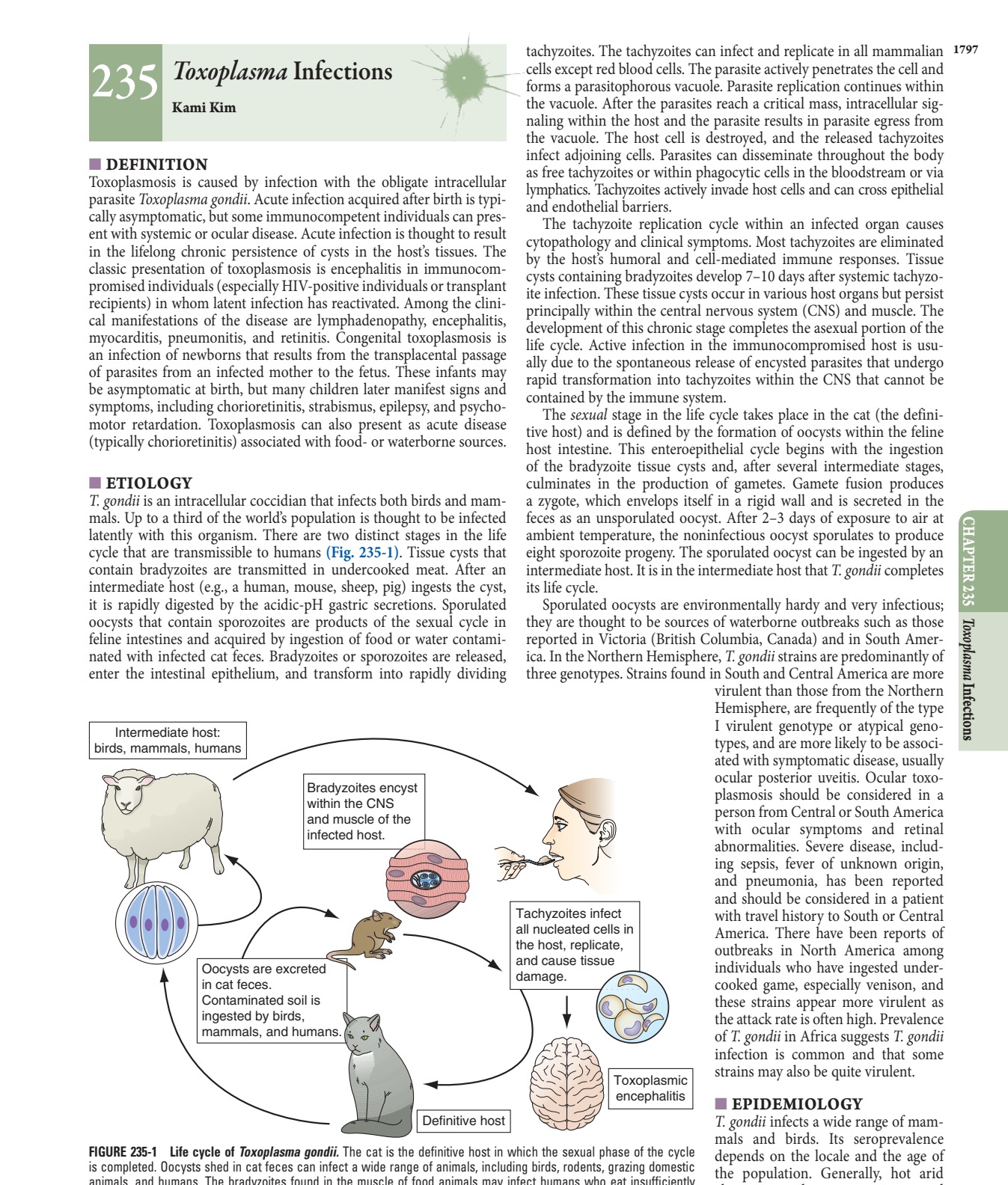
Caption: FIGURE 235-1 Life cycle of Toxoplasma gondii. The cat is the definitive host in which is completed. Oocysts shed in cat feces can infect a wide range of animals, including animals, and humans. The bradyzoites found in the muscle of food animals may infect cooked meat products, particularly lamb and pork. Although human disease can take and encephalitis from reactivation of latent infection in the brains of immunosuppressed manifestations. CNS, central nervous system. (Courtesy of Dominique Buzoni-Gatel,
Figure 2
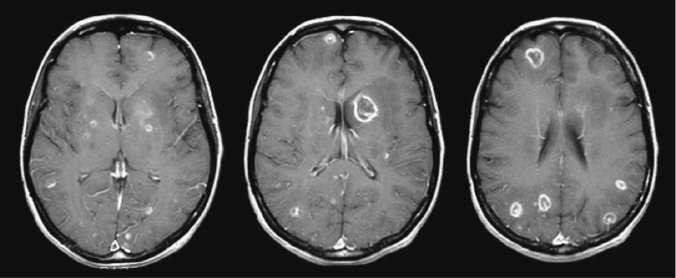
Caption: FIGURE 235-2 Toxoplasmic encephalitis in a 36-year-old patient with AIDS. The demonstrated by magnetic resonance imaging scanning (T1-weighted with (Courtesy of Clifford Eskey, Dartmouth Hitchcock Medical Center, Hanover, NH; with
Generated from Harrison's Principles of Internal Medicine, 22nd Edition.